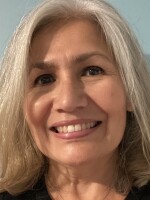
AUSTIN – At a recent potluck in Austin, Texas, pots of chicken and creamy potato soup simmer on the stove. It's the monthly meeting of Las Comadres Para Las Americas, or Godmothers for the Americas, where Latinas gather to connect. About two dozen show up carrying salads, cheese and fruit platters.
The group was founded by Nora de Hoyos Comstock 25 years ago. Back then, she says, she was searching for her Mexican roots.
"I didn't feel included in the Latino community. I always felt left out," she says.
Las Comadres has since become a national nonprofit organization. De Hoyos Comstock, petite with a warm smile, describes Las Comadres as a "Latina culture club."
The current political rhetoric, characterized by the most aggressive immigration enforcement in modern history, is forcing many U.S. citizen Latinos to question whether they belong.
De Hoyos Comstock, 80, says that she's been thinking for a while about how and whether Hispanics fit into the country's fabric.

"I look for myself on TV and in the media and I don't see myself because all I see is Latinos as criminals. I think about this every day," she says.
Typically, the group stays away from politics, says de Hoyos Comstock, but today they break that rule to talk about what they see as the Trump administration's assaults on Latinos as the U.S. turns 250 this year.
"It hurts me seeing all this injustice," says Gina Vazquez, a naturalized U.S. citizen. "Sometimes I cannot take it. I'm angry."

Many U.S. citizen Latinos are feeling afraid
When asked if any of the women or a family member voted for President Trump, nearly half of the group's hands go up. Several women at the gathering say they are angry at relatives who sent President Trump back to the White House, but they also feel hopeless and afraid.
"People are not understanding that there are no real rules right now," says Carolina Pérez, a U.S. citizen and the daughter of Cuban exiles who lived through the communist regime. Now with federal officers detaining and deporting immigrants around the country, she's terrified, she says.
Many in the group say they are conflicted about the nation's 250th birthday this year: they feel patriotic, yet not in a celebratory mood.
"Just the word celebration alone is triggering," says Evelyn Escamilla. "I'm Mexican-American. I was born in this country. I was raised in this country, yet because of my heritage, I'm afraid. I'm afraid to be out in the street. I don't think we have much to celebrate."

Millions of Hispanics voted for President Trump in 2024, but there is growing dissatisfaction with the administration's policies, especially on immigration and the economy, according to nationwide polling.
One of the first snapshots of where Trump's support among Hispanics currently stands may come as early as next week when statewide primaries in Texas will give us a glimpse into how voters are feeling about both Democrats and Republicans ahead of this year's midterm elections.
Daniel Garza, founder and president of The Libre Initiative, a conservative Latino nonprofit, says not everyone is worried about the Trump administration's immigration crackdown.
"If you're undocumented, yes, you should feel threatened. But if you're an American, naturalized or born citizen Latino, you don't have the same priority as that community does. Your priorities right now are the economy, jobs, opportunity."
The economy is one area where Latino contributions stand out. According to a recent UCLA report, Latinos provide about 70 percent of the growth in the national GDP and the labor force.
Another area where Latinos stand out is in the armed forces, where they are overrepresented in the largest branches.
Proud and patriotic Latino veterans
It's a busy morning at Joe's Bakery in Austin, Texas, a family-owned eatery famous for serving traditional Mexican breakfast all day, like migas, scrambled eggs with corn chips, and barbacoa with eggs, slow-cooked, shredded meat.
Chris Sanchez, 75, is one of a few veterans gathered there for a meal. He's a third generation American with Mexican roots.
"Latinos in the military, for us, we're not liberal. We're not conservative. We're Americans," he says. "I went into the military in 1968 and I got activated for Desert Storm. Latinos have always been very patriotic. They've been involved in every war."
Sanchez comes from a family with a long history of service. His five uncles and his father served in WWII and in the Korean War. His oldest brother served two tours in Vietnam, his younger brother served in the Texas National Guard. His son served in Afghanistan and his grandson is going through basic training in the Army, he says.
Benny Aleman spent 42 years in the military, including two deployments to Vietnam. He was a helicopter mechanic. He says today he doesn't recognize his country.

"We are in chaos! Our country is in chaos," he says.
He says the current administration's threats to seize or attack various nations, including Greenland, Iran and Venezuela, are unprecedented. He also disagrees with the Trump administration's tactics during the federal immigration crackdown in Minnesota.
"Do I disagree with Minneapolis? 100%. Period. You know, beating up on people, shooting people," says Aleman. "that's not America."
Federal immigration agents in Minnesota killed Renee Macklin Good, a mother and poet, and Alex Pretti, an ICU nurse at the Minneapolis VA Hospital.
Col. Frank Maldonado, 81, was a helicopter pilot in Vietnam whose parents came from Mexico. He enlisted in the army right out of high school.
"My mom did not want me in the military," he recalls as his eyes well up. "My dad was proud that he had given one of his sons to his adopted country. He was so proud."
Maldonado enlisted out of patriotism. His country needed him, he says, and he would do it all over again.
"War is terrible, especially for soldiers. But if my country really needed me, I would go right now, without even thinking."
He disagrees with the way Trump is running the country, but he remains hopeful, he says.

"One day we'll get back to what America should be. I'm not giving up," he says. "It's never going to be perfect, but every little bit that we can do to make it better, we got to continue."
Maldonado says he wouldn't miss celebrating his country's 250th birthday. He already has plans: a party with his kids and grandkids on the Fourth of July to set off some fireworks.
Copyright 2026 NPR