

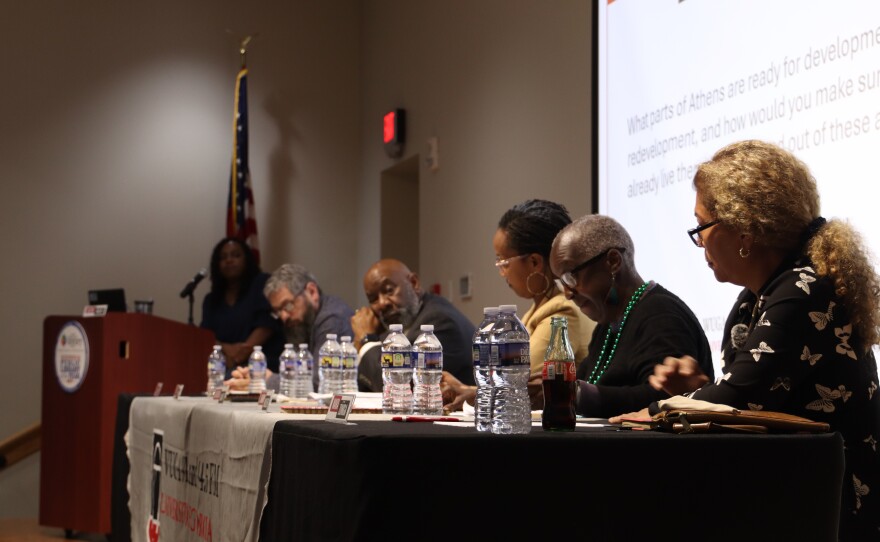


All five Athens mayoral candidates, Tim Denson, Dexter Fisher, Lakeisha Gantt, Sharon Miller, and Mara Zúñiga participated in the mayoral debate hosted by WUGA on Monday. Attendees filled almost every seat and lined the back wall of the Appleton Auditorium at the Athens-Clarke County Library on Baxter Street, which has a capacity of 150. WUGA News Director Alexia Ridley moderated the forum.
The candidates have gathered for several debates ahead of the 2026 election. Monday's debate covered several of the key issues that have so far defined this race, like affordable housing and homelessness, but touched on some other issues as well, like public safety.

Housing Crisis
The debate touched on the issue of affordable housing multiple times. Ridley referenced a quote from U.S. Senator Reverend Raphael Warnock, who called the housing situation in Georgia a “crisis.” Miller agreed with the reverend, citing her own perspective as a pastor.
“Finding housing for our unhoused is a moral commitment,” Miller said.

Gantt and Zúñiga both called for improvements in zoning laws, particularly with increasing flexibility for what is considered a home. The Athens-Clarke County Code, adopted in 1993, says that the minimum floor area requirement for single-family dwellings is 1,000 square feet, with some exceptions.
Denson and Fisher argued that more housing should be added in general. They agreed that Athens needs to diversify the types of housing it has.
“We’re building too much student housing,” Dexter said.
He focused on the “missing middle” and the need for more affordable, smaller homes. Dexter believes this would especially benefit young professionals moving to Athens.
The next question asked the candidates about future development in Athens.
“What parts of Athens are ready for development and redevelopment? None. We have overdeveloped,” Gantt said.
Gantt said she is worried that people are getting “priced out” of Athens and would rather focus on putting in protections for current residents. Miller and Zúñiga also agreed with her point about overdevelopment in Athens.
“Here’s the thought: Are we building because our communities need it, or are we building to accommodate an influx of populations?” Zúñiga said. “We say buying these new properties will bring prices down, but in the meantime, people are leaving.”
Fisher said he has noticed that many people do not want to increase density in their own neighborhoods to accommodate this “influx” of people.
Miller said rather than add new properties, she would look at “blighted properties” already owned by the county that could be turned into future housing. She emphasized that her main goal, though, is to protect working class Athenians.
“We've got to protect them and not allow developers to come in through a winsome contract and other leniencies and gifts that they will give,” Miller said.
On the other hand, Denson said he sees many areas that are ready for development, like Normaltown, Oglethorpe Avenue, North Avenue and Five Points. He said denser, “missing middle” housing in these areas could be added without taxing the infrastructure. Denson also advocated for allowing people to build accessory dwelling units on their properties.
“I faced it myself,” Denson said. “My in-laws stayed with us part of the year, and we couldn't put a kitchen down in their in-law suite because it's illegal.”
Single-family homes are allowed to have guesthouses, as long as they do not have “kitchen cooking facilities” in the unit, according to the Athens-Clarke County Code.
Safety vs. Surveillance
Some commissioners clashed on how to improve public safety in Athens.
Zúñiga started out the conversation on safety by referencing recent shootings and cases of sexual assault in Athens.
The Athens-Clarke County Police Department charged a man with rape earlier this year after a University of Georgia student reported that he had sexually assaulted her in downtown Athens on February 28. Two weeks later, one person was injured and two people died after a triple shooting in downtown Athens on March 14. There have also been other cases of gun violence and sexual assault in Athens this year.
Zúñiga said that violent crimes like these are why Athenians feel unsafe. She said policing tools like the Real Time Crime Center work but only after a crime has occurred. Her solution is to increase police presence and other preventative measures.
Denson expressed concern though that taking measures to increase safety could take away personal freedoms and privacy. He specifically pointed to the Flock Safety cameras that ACCPD uses to read license plates.
Fisher rejected the claim from Denson that private corporations can look at Athens’s camera feeds. Denson rebutted, encouraging audience members to research violations of Flock camera systems.

Flock Safety’s official position is that they have never had a data breach or leak, though people still have concerns about its security. Dunwoody recently deferred renewing its contract with Flock over these privacy concerns.
Fisher also said that he supports the work the RTCC has done, but sees a better solution than simply increasing police presence to decrease crime.
“For me, a tool like our Real Time Crime Center is a positive,” Fisher said. “But, at the same time real policing starts with people who are patrolling our areas getting out in the community, getting to know the folks that they're serving, and building relationships.”
Gantt said that pairing safety and surveillance is a slippery slope.
“We absolutely cannot make the mistake of… conflating safety with surveillance,” Gantt said.

Other key issues in the debate included data centers, homelessness and property and sales taxes.
WUGA will air the debate in two parts: Saturday at 10 a.m. and Monday at 8 p.m.. The entire debate will be available at 10 a.m. Saturday at WUGA.org and on the Athens News Matters podcast.
The Athens-Clarke County mayoral election will take place on May 19, 2026. Advance voting will be held from April 27 to May 15.
For more information, visit accgov.com/160/Elections-Department.


